How to Get Life Coaching Clients: Run One Four-Week Test
How to get life coaching clients: choose one audience, test one path for four weeks, and learn from real conversations before adding more marketing.
By Life Coaching Kit by Cosmo Suite · Editorial policy
Published · 8 min read
You have trained, chosen a coaching focus, and told a few people you are open for clients. Then you search for ways to get life coaching clients and find a familiar list: post every day, build a funnel, speak at events, start a podcast, ask for referrals, make a lead magnet. It is a lot to begin at once.
Pick one path and test it for four weeks. Start with a specific person and a problem they already want to work on. Make one useful invitation each week, then record who responds and what they need. That gives you a clearer next move than building five channels before you know which conversation fits.
Key takeaways:
- Choose one audience and one problem you can describe plainly.
- Test one place where those people already spend time.
- Make a specific invitation and give people room to decline.
- Track replies and useful conversations, not likes or promises.
Start with the problem people already ask you about
A discovery call is a short conversation where a coach and a potential client discuss what the person wants to change and whether coaching fits.
Start with a problem a particular person already asks about. “I coach people” gives a prospect little to recognize. “I help new managers prepare for difficult conversations” lets someone decide whether your work is relevant.
Write down three real questions people have brought to you. They might come from former colleagues, friends, clients from another role, or the professional groups you know. Choose the one you can discuss within your coaching scope and explain without a long introduction.
Then name the person who tends to ask it. You might focus on teachers moving into leadership, people returning to work after a break, or first-time managers. These are starting hypotheses. You can adjust the description as you hear how people talk about their situation.
Your focus does not need to be permanent. It only needs to make the next conversation easier to start. The coaching templates guide explains how paperwork can follow a client through the early stages of working together.
Client-finding paths: What to Use When
Choose a route that reaches people likely to have the problem and that you can repeat for a month. A new coach with a small network may get clearer feedback from a direct conversation or a small workshop than from trying to publish on every platform.
Direct outreach and teaching
| Path | What you do | Use it when | Signal to notice |
|---|---|---|---|
| Warm introductions | Tell relevant people who you help and ask whether someone comes to mind | You have past colleagues, peers, or community contacts | A person asks for an introduction or a short call |
| Small teaching session | Teach one practical idea in a local or online group | You can name a group whose members share the problem | Attendees ask about applying the idea to their situation |
Communities and content
| Path | What you do | Use it when | Signal to notice |
|---|---|---|---|
| Community participation | Answer a question in a group where your audience already gathers | You can contribute without turning every exchange into a pitch | Someone continues the conversation or asks what you offer |
| Focused content | Share a short article, post, or email about one recurring question | You can write for a channel your intended clients already use | A reader replies with a specific question or asks to talk |

Which route fits depends on the people you want to reach and the time you have. Greg Faxon’s article on the 21 approaches he tried includes blogging, email, workshops, social media, events, and referrals. Luisa Zhou’s advice on getting first coaching clients also stresses focusing effort on a small number of client-getting activities. Both sources offer practitioner guidance, not a guarantee that a method will work for your audience.
Faxon’s 10 September 2024 article groups his 21 approaches into three categories and says they worked differently for him. Use practitioner stories to find a route worth testing, then use your own conversations to see whether it fits your audience. Zhou makes a similar case for focusing on a handful of activities instead of doing every task that looks like marketing.
Build a four-week client-finding test
A four-week test keeps marketing small enough to do alongside client work or a day job. You choose one audience, one problem, one place to reach people, and one repeatable action. At the end, you review the conversations and decide whether to continue, change the invitation, or try a different path.
Use a simple note or table with these fields:
| Field | Example entry |
|---|---|
| Person | First-time managers in a local professional group |
| Problem | Preparing for a difficult conversation with a direct report |
| Place | Monthly peer meetup |
| Weekly action | Share one short practice prompt and invite discussion |
| Invitation | Offer a short call to explore whether coaching fits |
| What happened | Replies, conversations, questions, and follow-ups |
| Next decision | Repeat, adjust the wording, or test a different group |

Keep the record factual. “Four people liked the post” and “one person asked for a conversation” are different signals. Neither proves that the channel will bring clients. They help you see what happened and what you could reasonably test next.
Set a weekly action you can keep. For example, contact two people who know your work and ask whether they can introduce you to someone facing the problem you named. Or prepare one 20-minute teaching session for a group that already meets. The number is a manageable plan, not a performance benchmark.
At the end of each week, note what people asked in their own words. If the same question appears several times, use that language in your next invitation. If people are interested in the topic but not coaching, ask what kind of support they were looking for. Do not change the whole offer after one quiet week.
Make the invitation easy to answer
A useful invitation says who you help, what you can talk about, and what the person can do next. It should feel specific enough to understand and light enough to decline. Avoid sending a generic “let me know if you need anything” message that leaves all the work to the other person.
For a warm contact, you could write:
I’m starting to work with new managers who want to prepare for difficult conversations. If someone comes to mind, would you be comfortable introducing us? No problem if not.
For a group post, share a short exercise or question first. Then explain that you coach people working through that problem and invite interested readers to message you. Check the group rules before you post, and contribute to the group even when nobody asks about coaching.
Keep the invitation truthful. Do not promise that one call will fix a problem or that a certain number of sessions guarantees a result. If you share ideas on social media, Life Coaching Kit has editable social media and lead magnet templates that can help prepare the materials. If someone is not looking for coaching, accept that answer. A clear no is better information than an awkward sequence of follow-ups.
Run a discovery call that checks fit
A discovery call helps both people decide whether coaching fits the situation. Explain how long you have, ask what the person wants to discuss, and let them describe what they have tried. Then outline how you work and what the person could choose next.
You can organize the conversation around four questions:
- What would make this conversation useful today?
- What is happening now, and what would you like to be different?
- What have you tried so far, and what feels difficult about the next step?
- Would you like to hear how coaching with me might work?

The call is also your chance to check your own fit. Can you coach within the person’s request and your competence? Are expectations clear? Do your session format, availability, and fees suit both of you? If the person needs another kind of support, say so and suggest they look for an appropriate professional.
If you both want to continue, explain the scope, fee, schedule, cancellation terms, and next step in writing. A coaching agreement template can help you plan the points to discuss. Have any agreement reviewed for your location before using it with clients.
Follow up and read the signal
Follow up once with the detail the person asked for. If they wanted time, give them time. If they declined, thank them and close the loop. Keep private client information out of a marketing tracker; record only the minimum you need to remember your next action.
Look at the sequence, not a single public metric. Did the invitation reach the right people? Did anyone reply with the problem you expected? Did conversations lead to a mutual decision? If not, identify the step that needs attention. The audience, channel, wording, and call format are separate parts of the test.
The 2023 Global Coaching Study from the International Coaching Federation (ICF) reported that 24% of surveyed coach practitioners had four or fewer clients in 2022. That figure describes the respondents at one point in time. It does not predict what a new coach should have, and it is not a reason to compare your first month with someone else’s practice.
When people show interest but do not understand the next step, clarify the invitation. When the right people do not see it, try a more relevant group or contact. When conversations happen but the fit is poor, revisit whom you are trying to serve. Make one change at a time so you can tell what changed the response.
Prepare the client materials once the path is clear
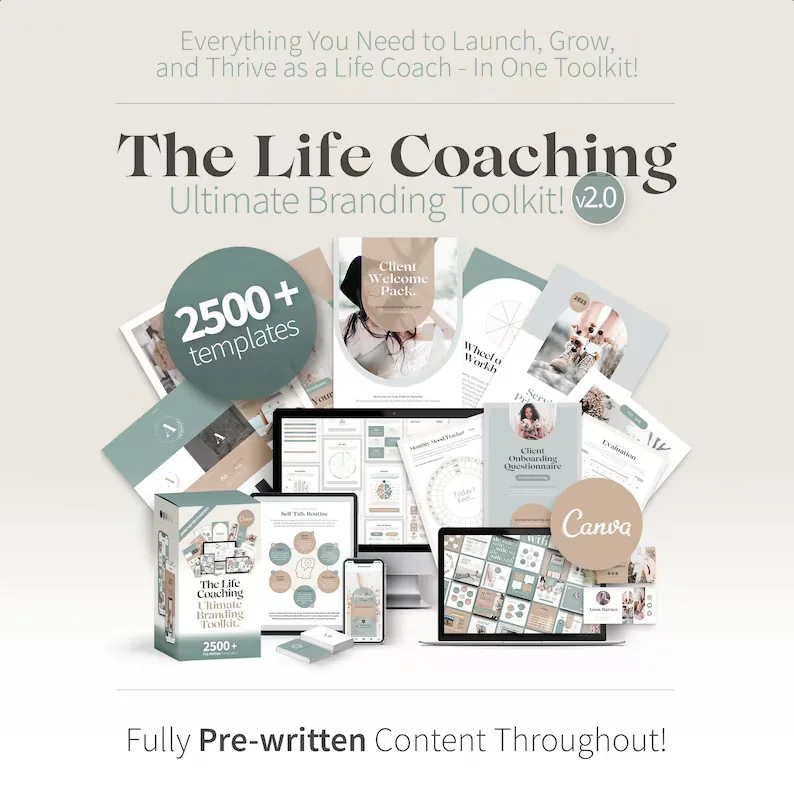
Marketing can bring someone to a conversation; your client materials help you prepare for the work that follows. Life Coaching Kit includes customizable Canva templates for business branding, client forms and workbooks, social media, and lead magnets. It does not provide booking, payment, or client-portal software.
We make Life Coaching Kit, so this is a product mention. The kit is a collection of editable templates, not a promise of clients or a substitute for choosing a marketing path. You can read more about the company on our /about page and how we make articles on our /editorial policy.
If you are preparing for your first few clients, the kit’s client forms and workbooks may help you organize intake and follow-up materials. Its social media and lead magnet templates may help you present one useful idea consistently. Use them after you know what you want to say. Your next marketing task can stay small: one audience, one invitation, and one honest review of the response.
Frequently asked questions
What is the fastest way to get life coaching clients?
Start with people who already know your work or can introduce you to the people you want to serve. Describe one problem you help with and invite a suitable person to a short conversation. There is no reliable fastest route for every coach, so treat the first few weeks as a test of fit and response.
How do I get my first life coaching client with no audience?
Choose a specific kind of person and a problem they are already trying to solve. Ask people in your existing network for relevant introductions, take part in a community where those people already gather, or offer a small useful teaching session. Make one clear invitation and follow up respectfully.
Do life coaches need social media to find clients?
No single channel suits every coach. Social media can help when your intended clients use it and you can share useful, specific material there. Direct conversations, referrals, local groups, workshops, or focused articles may fit better. Test one route before you commit to a schedule across several platforms.
What should I say when marketing life coaching?
Name the person you work with, the problem they want to address, and the next step you offer. For example: “I work with people changing careers who want to make a considered plan. I’m offering a short conversation to see what questions are coming up.” Keep the invitation accurate and avoid promising a result.
How many clients should a new life coach expect?
There is no dependable number to promise. The [ICF’s 2023 Global Coaching Study](https://coachingfederation.org/resources/research/global-coaching-study/) reported that 24% of coach practitioners surveyed had four or fewer clients in 2022, but that describes a broad group, not a forecast for a new coach. Use your own replies and conversations to decide what to test next.
What should happen after someone agrees to a discovery call?
Confirm the time, explain what the conversation will cover, and ask what would make it useful for them. During the call, discuss their situation, what they want to change, and whether your coaching is a suitable fit. Share your terms and next step clearly, then let them decide without pressure.