Free Coaching Agreement Template: 10 Clauses to Copy and Customize
Coaching agreement template in 10 clauses: what each one says, what it prevents and sample wording to adapt, plus the ICF ethics standards behind them.
By Life Coaching Kit by Cosmo Suite · Editorial policy
Published · 9 min read
A client paid for a 12-session package. In week two they cancel an hour before session three and ask for that money back. What does your agreement say?
If the answer is "I don't have one", you can fix it this week. Start from an editable coaching agreement template you fill in for your practice, then add the ten clauses below. Neither a one-page letter nor a ten-page contract written for corporate coaching will settle that cancellation.
Key takeaways:
- A solo coach needs ten clauses, and each one prevents a specific dispute.
- Seven of the ten map to a named standard in the ICF Code of Ethics. The other three are business terms you have to write yourself.
- Sessions, cancellation and ending terms cause most arguments, so give them real numbers.
- A template is a draft. Have the final version reviewed where you practice.
Below you'll find each clause, what it prevents and wording to adapt. Where an International Coaching Federation (ICF) standard applies, we quote it. This isn't legal advice.
Why the Agreement Is an Ethics Document, Not Just a Form
A coaching agreement is the signed document that sets the terms of the work between you and your client: what you deliver, what it costs and how it ends. It's also the written form of what the ICF asks every coach to agree on before coaching starts.
The ICF Code of Ethics is the conduct standard the International Coaching Federation sets for its members and credential holders. Standard 1.1 of the ICF Code of Ethics asks coaches to "co-create a coaching agreement regarding roles, responsibilities, confidentiality, financial arrangements, and other aspects of the coaching engagement".
In other words, read that line as a checklist. Roles, responsibilities, confidentiality and money each become a clause. Standard 1.2 adds the right of either side to end the relationship, "subject to the provisions of the agreement". As a result, your ending terms belong in writing too.
The agreement also guards the line between coaching and therapy. For example, say you're a therapist adding coaching on the side. Or a client starts talking about a crisis. In both cases you need a written answer to "what happens if this is more than coaching?"

Coaching Agreement Clauses: What to Use When
Ten clauses cover a solo practice. Here they are with the problem each one prevents.
| # | Clause | What it prevents | Use it when |
|---|---|---|---|
| 1 | Parties and services | "I thought this included email support" | Always |
| 2 | Nature of coaching | Coaching being taken for therapy | Always |
| 3 | Sessions and package | Disputes over how many sessions remain | Always |
| 4 | Fees and payment | Late or missing payments | Paid clients |
| 5 | Cancellation and rescheduling | Same-day cancellations, no-shows | Always |
| 6 | Confidentiality and its limits | Surprises about what you share and when | Always |
| 7 | Records and data | Unclear storage of notes | Always |
| 8 | Client responsibilities | A client expecting results without the work | Always |
| 9 | Ending the agreement | A stalled package with no exit | Always |
| 10 | Signatures and date | "I never agreed to that" | Always |
In fact, only clause 4 changes for a free client. The other nine apply to every coaching relationship you start.
The 10 Clauses, With Wording to Adapt
Adapt all ten. Clauses 3, 5 and 9 need the most thought, because they set the numbers clients dispute. Each clause has sample wording, with the parts to change in brackets.
1. Parties and Services: Name Exactly What Is Included
Name you, the client and the service. For example: "[12] coaching sessions of [60] minutes by video, plus [email support between sessions, replies within 2 working days]." Anything not named isn't included.
Use it when: always. Most scope arguments start with a vague first clause.
2. Nature of Coaching: Say What Coaching Is Not
State that coaching is a partnership focused on the client's goals. Specifically, say it isn't therapy, counseling, or medical, legal or financial advice. Add what you'll do if a client needs other help: "If [I believe you would benefit from other professional support], I will tell you and may suggest a referral".
Use it when: always, and especially if your background is in therapy, nursing or HR. ICF standard 3.7 asks coaches to tell clients when they act in a role other than coach.
3. Sessions and Package: Count Them
Give the number of sessions, their length and the window they must be used in. Then say what happens to unused ones: "Sessions are to be used within [16] weeks of the first session. Unused sessions [expire / can be extended once by 4 weeks]."
Use it when: always. In particular, a coach moving from $75 single sessions to a 3-month package needs this one most.
4. Fees and Payment: Amount, Dates, Method
Write the total fee, the schedule ("[3] payments of [$X] due on [the 1st of each month]") and the accepted methods. Then say what happens when a payment is late: "Sessions are paused until the payment is received."
Use it when: for every paid client. However, leave it out for pro bono work.
5. Cancellation and Rescheduling: Pick a Notice Period
A cancellation window is the notice period inside which a cancelled session counts as used. Pick one and write it down: "Sessions cancelled with less than [24] hours' notice are counted as used." Add how many reschedules you allow and how you handle lateness.
Use it when: always. Write it before your first paid session, not after the first late cancellation.
6. Confidentiality and Its Limits: Promise What You Can Keep
Promise confidentiality, then name the exceptions: a risk of serious harm to the client or others, or a legal duty to disclose. A sponsor is a third party, such as an employer, who pays for the coaching. If there is one, say what they will hear. The ICF Code asks for "a clear agreement about what information is exchanged and how it is exchanged among all parties" (standard 2.2).
Planning to record sessions, for example for an ICF credential application? The ICF publishes a sample release of confidential information form for that client consent.
Use it when: always, and in more detail when a third party pays.
7. Records and Data: Where Notes Live
Say what you record, where you store it, who can see it and how long you keep it. For instance: "I keep [session notes and completed worksheets] in [a password-protected folder]. Only I can see them, and I delete them [2 years] after our last session". Standard 2.4 asks coaches to store and dispose of records in a way that "promotes confidentiality, security, and privacy, and complies with applicable laws and agreements".
Use it when: always. That said, data rules differ by country, so have this clause reviewed.
8. Client Responsibilities: The Work Is Theirs
Make the client responsible for their decisions, actions and results: "You are responsible for your choices and results. You agree to [attend on time], [complete the agreed actions between sessions] and [tell me if coaching is not working for you]."
Use it when: always. It keeps "you didn't get me the promotion" off the table.
9. Ending the Agreement: A Way Out for Both
Either side can end the agreement with [7 days' written notice]. Say what happens to fees for unused sessions: refunded, partly refunded or not refunded. Clear terms here make standard 1.2 work in practice.
Use it when: always. A clean exit is better for the client and for your reputation.
10. Signatures and Date: Both Names, One Version
Add both signatures, the date and the version: "Agreement version [1.0, October 2026]. Signed by [client name] on [date] and [your name] on [date]." Keep a signed copy for each of you.
The ESIGN Act is the US federal law on electronic signatures. Under 15 U.S. Code § 7001, a contract "may not be denied legal effect, validity, or enforceability solely because an electronic signature or electronic record was used in its formation". However, outside the US, check your local rules.
Use it when: always, before the first session or invoice.
Which Clauses the ICF Code Covers, and Which It Leaves to You
[Original data] We compared each of the ten clauses with the standards in the ICF Code of Ethics. Seven clauses map to a named standard. Three don't.
| Clause | ICF standard it puts in writing |
|---|---|
| 1. Parties and services | 1.1 (roles, responsibilities) |
| 2. Nature of coaching | 1.1 (explain the nature of coaching), 3.7 |
| 4. Fees and payment | 1.1 (financial arrangements) |
| 6. Confidentiality | 1.1, 2.2 |
| 7. Records and data | 2.4 |
| 8. Client responsibilities | 1.1 (responsibilities) |
| 9. Ending the agreement | 1.2 |
| 3, 5 and 10 | None: business terms you write yourself |
In other words, the ICF gives you principles for seven clauses and nothing to copy for sessions, cancellation and signatures. Those three are where package disputes usually start.
What a Missing Cancellation Clause Costs: A Worked Example
[Unique insight] The cost of a weak agreement shows up in clauses 3 and 5, so put numbers on them before you sign anyone.
For example, consider a coach selling a 3-month package: 12 sessions of 60 minutes for $1,800, paid as 3 payments of $600. That's $150 per session.
- No cancellation window: the client cancels three sessions on the day. Each one either becomes a free reschedule or an argument. Three of them is $450 of booked time.
- A 24-hour window: those three late cancellations count as used. The client knew the rule when they signed.
- No unused-session rule: the package drifts. Twelve sessions planned for 12 weeks can stretch past 30.
- A 16-week window: the package ends at week 16 at the latest, and your calendar frees up for the next client.
That said, you don't have to enforce every rule every time. With a written rule, the awkward talk becomes a reminder of what you both signed. For the full set of client documents around this one, read the coaching templates guide for your first 90 days.
The Clauses Most Free Templates Leave Out
A short template that covers only parties, fees and signatures (clauses 1, 4 and 10) leaves these gaps.
No definition of coaching. Without clause 2, a client in distress has no written reason to see a therapist instead, and that is a safety risk.
No unused-session rule. Packages without an expiry stretch on for months. Clause 3 with a time window keeps them moving.
Confidentiality with no limits. "Everything is confidential" is a promise you can't keep in every case. Name the exceptions in clause 6.
No sponsor terms. When an employer pays, clause 6 must say what the employer hears. The ICF's case study on Standard 1.1 notes that "a well-defined coaching agreement should cover confidentiality, boundaries, and expectations and should be revisited when circumstances change".
No review step. A template is a draft. A short review by a lawyer where you practice costs far less than a dispute. If you want the gaps closed before that review, start from a coaching agreement page that already has room for all ten clauses.
Where the Life Coaching Kit Fits
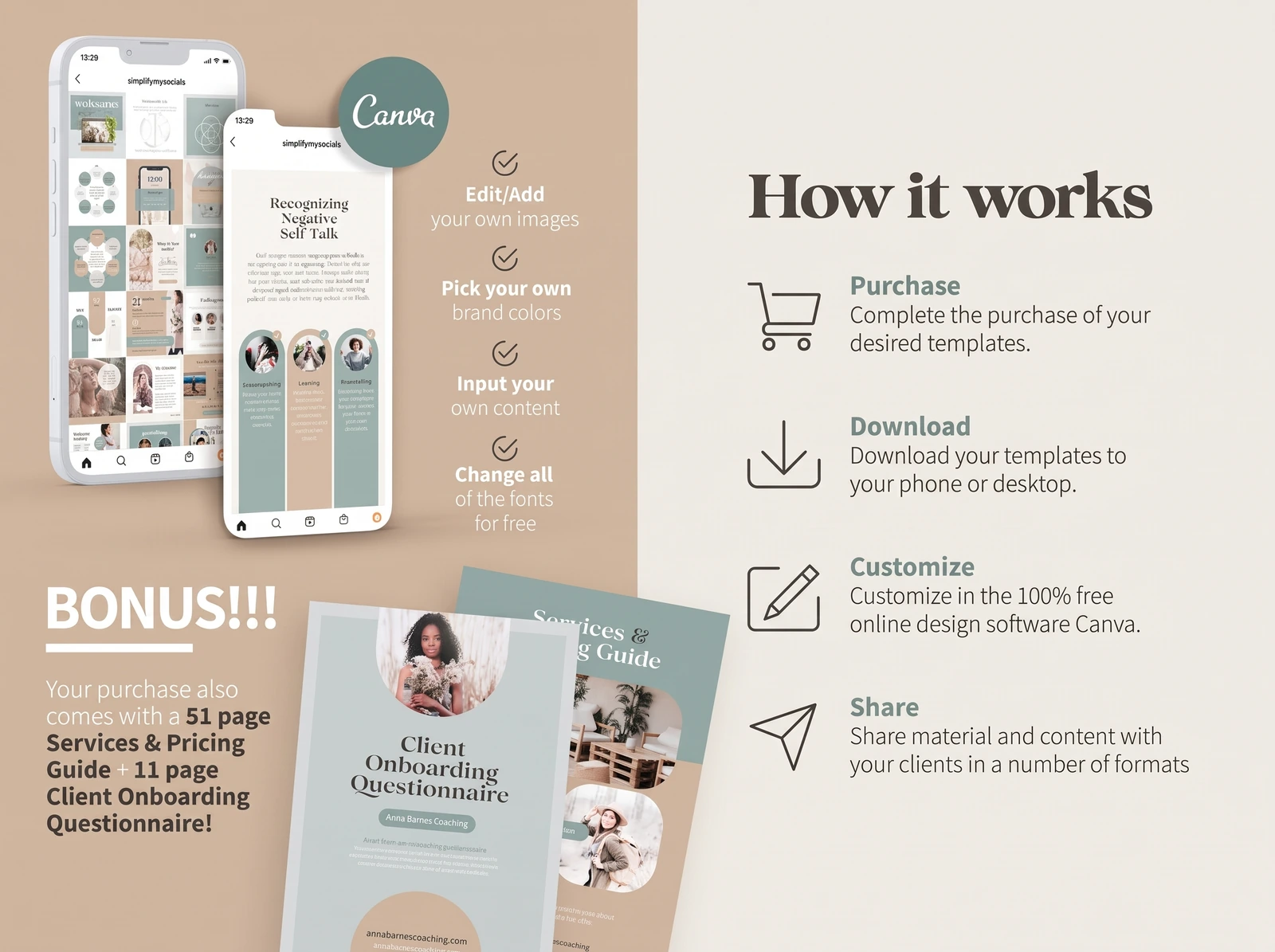
The slow part is the blank page you face on the day a client says yes. The Life Coaching Kit gives you an editable agreement page, so you write the ten clauses into a designed document.
Specifically, the agreement sits among 32 client forms, next to the intake, evaluation, session, review and referral request pages, in US Letter and A4. It opens in Canva, and a free account works. You add the clauses in your own words, with your logo and colors, then export a PDF to send for signature.
The same kit has a 44-page client welcome pack to send once the agreement is signed. A 51-page goodbye pack covers the end of the package.
How we put this together. Our methodology: we read the ICF Code of Ethics line by line and matched each standard to a clause, as the table above shows. The clause list and sample wording are ours. Every ICF quote comes from the ICF's own pages, checked on 3 October 2026. We are the Cosmo Suite team behind the kit, and you can read about us and the company behind this site or our editorial policy. However, we aren't lawyers, so have your agreement reviewed for your location. Questions? Use the contact page.
To see the agreement and the other client forms, look at the 32 editable client forms, agreement included.
Frequently asked questions
Is a coaching agreement the same as a coaching contract?
Mostly, yes. Both cover services, fees, cancellation, confidentiality and how the work ends. Some coaches call the signed, paid version a contract and the shared expectations an agreement. Use the word your clients understand, and keep one signed document per client.
Do I need a coaching agreement for free or pro bono clients?
Yes. A free client still needs to know how many sessions they get, how confidentiality works, what coaching is not and how either of you can stop. Drop the fee clause and keep the other nine. Practice clients are often where boundary questions come up first.
Can I sign a coaching agreement electronically?
In many places, yes. In the US, the federal ESIGN Act says a contract can't be denied legal effect just because it was signed electronically. Other countries have their own rules, so check what applies where you and your client live, and keep a signed PDF for both of you.
How long should a coaching agreement be?
Two to four pages is enough for a solo coach. Ten clauses, each a short paragraph, cover the essentials. Long agreements get skimmed, and a skimmed cancellation clause is easy to dispute later. Put session dates in the welcome packet, not the agreement.
When should I update my coaching agreement?
When something real changes: a new price, a new package length, a new cancellation rule, a move abroad, or an employer paying for the coaching. Review it once a year even if nothing changed. Add a line on how changes are agreed, and have a lawyer confirm it for your location.
What is the fastest way to get a coaching agreement ready this week?
Start from an editable template instead of a blank page, write the 10 clauses for your practice, then ask a lawyer for a short review. The Life Coaching Kit has a coaching agreement among its 32 client forms, editable in Canva with your logo and colors.
Sources
Keep reading

Client Paperwork
Coaching Session Notes Template: What to Write Down in 5 Minutes After Each Client Session
coaching session notes template: what to capture after each client session, what to leave out, and how to keep a one-page note useful in about five minutes.
· 7 min read

Client Paperwork
A Client Welcome Packet That Answers the First Questions Before Session 1
Client welcome packet: the 7 pages to include, the order clients ask their questions in, what to keep out, and a worked example of the first hour.
· 9 min read
Client Paperwork
How to Write a Life Coaching Intake Form (Without a 40-Question Wall)
Life coaching intake form: 15 questions in 5 groups, each tied to what it changes in session one, plus 8 questions to cut and a worked example.
· 10 min read