Life Coaching Forms: What to Have Ready Before Your First Client Session
Coaching forms for a solo life coach: 11 in client order, 10 the client sees, the 5 to have ready before session one, and which to fold in or skip.
By Life Coaching Kit by Cosmo Suite · Editorial policy
Published · 11 min read
Search for coaching forms and the top lists hand you 16 to 19 of them. They include discovery forms, consent packets, waivers, assessments and proposals. If you have one client starting next week, that list reads like homework you can't finish.
Your first client will touch far fewer. Some forms on those lists are clauses that belong inside your agreement. Others only matter at client 20, or only in a health or couples niche. A few matter on day one, and missing them costs you a session.
So count by client moment. Below is the full list a solo life coach uses, in the order a client meets it, with what you can fold in or skip. If you'd rather edit than design, a set of client forms grouped by stage follows the same order.
Key takeaways:
- A solo life coach uses about 11 forms: 10 the client sees and a session notes page only you see. Only 5 need to be ready before session one.
- Consent, cancellation, confidentiality and terms usually belong inside the coaching agreement, not on separate pages.
- How you sell changes which forms repeat: single sessions repeat invoices, packages repeat notes and check-ins.
- Decide where client records live and when you delete them before the first intake form comes back.
The Short Answer: 11 Forms, and 5 Before Session One
A solo life coach needs about 11 forms, 10 of them client-facing. Five must be ready before the first session: the coaching agreement, intake form, invoice, welcome letter and a session notes page. Three run during the package and three close it. The longer lists online add niche, business and duplicate forms you can skip.
Coaching forms are the documents a client signs, fills in or receives, plus the pages you complete about them: agreements, questionnaires, invoices, notes, reviews and closing pages. They are the paper side of a coaching relationship.
The first one is not optional. Standard 1.1 of the ICF Code of Ethics asks coaches to "co-create a coaching agreement regarding roles, responsibilities, confidentiality, financial arrangements, and other aspects of the coaching engagement" before coaching begins. That single line already covers four of the forms the long lists give separate pages.
[Original data] We counted the two long lists in the US results for "coaching forms" on 4 October 2026: Paperbell's names 19 templates and PositivePsychology.com's names 16. Neither says which ones a new coach needs first. Several entries are niche (nutrition waivers, couples intake) or business tools (proposals, program applications).
Life Coaching Forms: What to Use When
Eleven forms cover a solo practice from the first yes to the last session. Ten are client-facing, meaning the client signs, fills in, reads or keeps them. The eleventh, your session notes page, stays with you. Here they are in client order, with who touches each one.
| # | Form | Client stage | Who touches it | Use it when |
|---|---|---|---|---|
| 1 | Coaching agreement | Yes, before payment | Client signs | Always |
| 2 | Intake form | Days 1-3 | Client fills in | Always |
| 3 | Invoice or receipt | At payment | Client receives | Paid clients |
| 4 | Welcome letter or packet | Within an hour of payment | Client reads | Always |
| 5 | Session notes page | After every session | Coach only | Always |
| 6 | Pre-session check-in | A day before each session | Client fills in | Clients who arrive unprepared |
| 7 | Action list | End of each session | Client keeps | Sessions that set homework |
| 8 | Mid-point review | Around the middle of a package | Both | Packages of 8+ sessions |
| 9 | Feedback form | Final session | Client fills in | Always |
| 10 | Testimonial permission | After good feedback | Client signs | Only if you will quote them |
| 11 | Referral request | Final week | Client receives | Happy clients |
Look at the "who touches it" column first. Every form a client handles shapes how your practice feels to them, so those ten deserve your best wording. Your session notes page only has to work for you.
Before Session One: The Five Forms You Can't Skip
The five pre-session forms are the agreement, intake form, invoice, welcome letter and notes page. Together they answer what the client agreed to, who they are, what they paid, what happens next and where you'll record the work. Without any one of them, session one starts with admin instead of coaching.
Coaching Agreement: Signed Before Any Money Moves
A coaching agreement is the signed document that sets sessions, fees, cancellation, confidentiality and how either of you can end the work. It's also where you say what coaching is not, and when you'd refer a client to another professional. Our clause-by-clause coaching agreement template guide covers the wording. Have the final version reviewed for your location.
Use it when: a client says yes on a discovery call, before you send the invoice.
Intake Form: Only Questions That Change Session One
An intake form is the questionnaire a client completes before session one. Keep it to 12 to 20 questions. Contact details, the goal in the client's words, what they've tried, what success looks like when the package ends, how they like feedback and anything you need to know to keep the work safe. If an answer wouldn't change how you run session one, cut the question.
Use it when: the agreement is signed, at least two days before session one, so you have time to read it.
Invoice or Receipt: One Line Per Package
The invoice shows the package or session, the dates it covers, the amount and how to pay. Package clients get one invoice, or one per instalment. Single-session clients get one per session, which is why this form repeats most in a pay-as-you-go practice.
Use it when: the agreement is signed. Send a receipt the day payment arrives.
Welcome Letter or Packet: Answers Before They Ask
The welcome letter covers how sessions run, how to book and reschedule, what to prepare and how to reach you between sessions. It saves you writing the same email to every client. A longer packet can add your approach, a first reflection page and a short FAQ.
Use it when: within an hour of the first payment, while the decision still feels fresh.
Session Notes Page: The Only Form Clients Never See
Notes record the client's own words, the commitments made, the homework set and anything to follow up. Have the page ready before session one, so you fill it in the same day instead of reconstructing the hour from memory three days later.
Use it when: right after every session, for 5 to 10 minutes.
During the Package: Three Forms That Keep Clients on Track
During a package, three forms do the work. A pre-session check-in means clients arrive with a topic. An action list puts commitments in writing, and a mid-point review checks the goal still fits. None is needed on day one. Add them by the time your first client reaches session two.
The pre-session check-in. Three or four questions sent the day before: what happened since last time, what got done, what they want from this session. A client who answers them arrives with a topic, and you skip ten minutes of warm-up. Use it if clients often arrive saying "I'm not sure what to talk about today".
The action list. One page the client keeps: what they committed to, by when, and how they'll know it's done. It's the bridge between sessions, and it gives the next check-in something concrete to ask about.
The mid-point review. Halfway through a package, ask whether the goal from the intake form still fits, what's working and what to change. This is where a drifting engagement gets back on course, or where you both agree it's time for something other than coaching.
At the End: Three Forms That Bring the Next Client
The last week needs three forms: a feedback form, a testimonial permission form and a referral request. Feedback tells you what to keep. Permission lets you quote a happy client without guessing. The referral request asks for the next client while the result is still fresh in the current one's mind.
The feedback form. Ask what changed, what helped most, what you could do better and whether they'd recommend you. Five questions are enough. Open questions get better answers than a 1-10 scale on its own.
Testimonial permission. If a client writes something kind, ask in writing before you quote it. Say where it will appear, whether you'll use their full name, initials or nothing, and that they can withdraw it. Keep it short: one paragraph and a signature. Quote their words as written, too. In the US, the FTC's guidance on endorsements says "An endorsement must reflect the honest opinion of the endorser".
The referral request. A short page or email: who else might benefit, and a link to book a discovery call. It works best right after the feedback form, when the client has just put the result into their own words.
Forms You Can Fold In or Skip for Now
About half the forms on the long lists are really clauses of your agreement or questions in your intake form. Others are tools for a niche or a bigger practice. Fold the first two kinds in. Skip the rest until a real client situation calls for them.
| Form on the long lists | Where it goes instead | When it earns its own page |
|---|---|---|
| Consent form (what coaching is and isn't) | "Nature of coaching" clause in the agreement | If a lawyer advises a separate one where you practice |
| Cancellation policy | Agreement clause, repeated in the welcome letter | Rarely |
| Confidentiality form | Agreement clause | When an employer or sponsor pays for the coaching |
| Terms and conditions | The agreement | When you sell group programs or courses online |
| Discovery call questionnaire | Two questions on your booking page | When inquiries outnumber your free slots |
| Session recording release | Nothing, if you don't record | When you record sessions, for example for an ICF credential application |
| Niche assessments and waivers | Skip | Health, fitness or couples niches |
The recording release is the easiest one to overlook. The ICF publishes a sample release of confidential information form for coaches who submit a recorded session with a credential application. If you record for any reason, get that consent in writing first.
How the Count Changes With How You Sell
[Unique insight] The 11 form types stay the same whether you sell single sessions or packages. What changes is which forms repeat. Single sessions repeat the invoice. Packages repeat notes, check-ins and action lists, and only packages need a mid-point review.
For example, take two clients who each work with you for a while. One books six single sessions, one at a time. The other buys a 12-session package with weekly sessions.
| Form | Single sessions (6) | Package (12 sessions) |
|---|---|---|
| Coaching agreement | 1 | 1 |
| Intake form | 1 | 1 |
| Invoice or receipt | 6 | 1 |
| Welcome letter | 1 | 1 |
| Session notes | 6 | 12 |
| Pre-session check-in | 6 | 12 |
| Action list | 6 | 12 |
| Mid-point review | 0 | 1 |
| Feedback, permission, referral | 3 | 3 |
| Total documents | 30 | 44 |
The single-session coach spends their admin time on invoices, so a clean invoice template pays off first. The package coach spends it on the three per-session pages, so those three should be fast to fill in. Either way, the forms you write once (agreement, intake, welcome) are the ones worth getting right first.
The Part Most Form Lists Leave Out
Lists tell you which forms exist. They rarely mention five decisions that make forms work: one look, no repeated questions, where records live and for how long, a written scope line, and a reviewed agreement. None of them takes more than an evening, and any one can save an awkward conversation later.
One look across every form. A client sees your agreement, intake form, welcome letter, invoice and closing pages within a few weeks. Matching fonts, colors and logo make them read as one practice. Starting from client forms and on/offboarding packs that already share one design saves matching them by hand.
Never ask the same question twice. If the discovery call asked about the goal, the intake form asks what success looks like instead. If the intake form covered history, the check-in sticks to this week.
Decide where records live, and for how long. Session notes and intake answers are personal data. Standard 2.4 of the ICF Code of Ethics asks coaches to "maintain, store, and dispose of any records, including electronic files and communications, in a manner that promotes confidentiality, security, and privacy". The UK regulator puts it plainly in its storage limitation guidance: "You must not keep personal data for longer than you need it." Pick one folder per client and a deletion date before the first intake form arrives.
Write the scope line once. Coaching isn't therapy. Standard 4.3 asks coaches to explore "the potential for a different coach, professional, or resource" when the value of coaching shifts. Put one sentence about referral in the agreement and one in the welcome letter.
Have the agreement reviewed. A template is a draft. Ask a lawyer where you practice to check it before your first paying client signs. For how these forms fit with session plans, worksheets and the first 90 days, see our stage-by-stage guide to coaching templates.
Where the Life Coaching Kit Fits
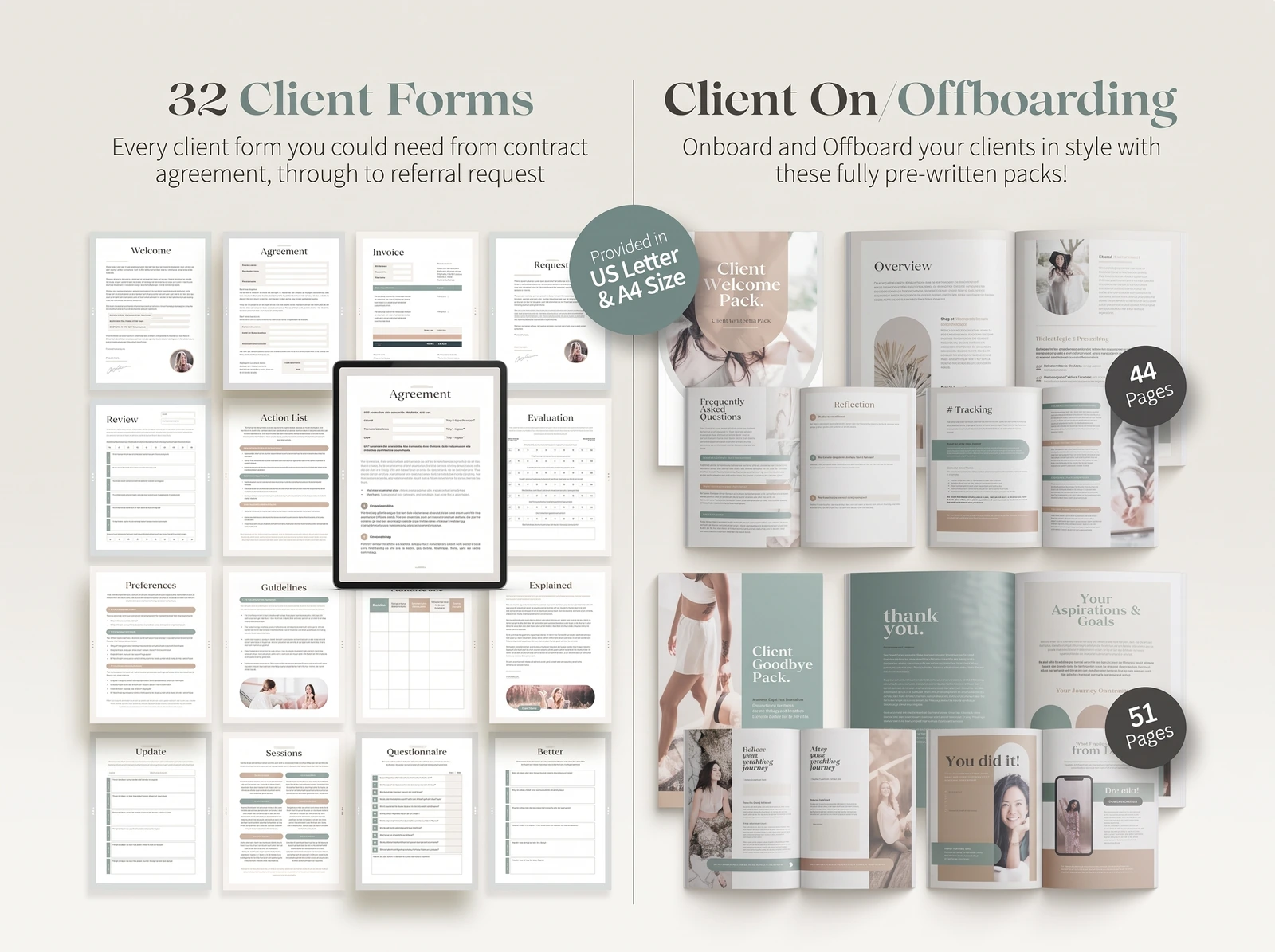
The Life Coaching Kit covers most of the 11 forms in one Canva set, so you edit instead of design. Its client forms section holds 32 forms in US Letter and A4, and the onboarding and offboarding packs cover the welcome and closing stages. You add your words, logo and colors.
Here is what's in it for the forms above, counted from the kit's contents page:
- Client forms: 32 pages, from the agreement through to a referral request. Page titles include Agreement, Questionnaire, Invoice, Welcome, Sessions, Action List, Review and Evaluation.
- Onboarding: a 44-page client welcome pack and an 11-page client onboarding questionnaire.
- Offboarding: a 51-page client goodbye pack.
- Between sessions: 150+ worksheets and four pre-written workbooks.
It does not include a testimonial permission form, so write that one-paragraph page yourself. It also isn't booking or payment software. If you later move to a coaching platform, you paste your own wording into its forms.
How we put this together. We are the Cosmo Suite team that sells the Life Coaching Kit. Our methodology: the 11-form list, the fold-in table and the worked example are our own analysis of a solo practice, built on the ICF Code of Ethics. The two lists we counted and the ICF, ICO and FTC quotes were checked on 4 October 2026. Read about us and the company behind this site and our editorial policy. None of this is legal advice, so have your agreement reviewed where you practice.
You can see every client form, the welcome pack and the goodbye pack before you decide.
Frequently asked questions
How many forms does a new life coach need before the first session?
Five. A signed coaching agreement, a completed intake form, an invoice or receipt, a welcome letter or packet, and a blank session notes page ready for after the call. Everything else can be added during the first month, while the client is in early sessions.
Do I need a separate consent form for life coaching?
Usually not. What most consent forms cover (what coaching is and is not, confidentiality and its limits, cancellation) fits inside the coaching agreement as clauses. A separate form makes sense if you record sessions or if a lawyer advises one for your location, so have the final version reviewed.
Can clients fill in coaching forms online?
Yes. You can send a designed form as a PDF for clients to sign and return, or copy the same questions into a free online form tool so answers arrive typed. Keep the wording identical in both versions, and store the replies with the rest of that client's file.
How long should a life coaching intake form be?
Between 12 and 20 questions for most solo practices. Ask for contact details, the goal in the client's words, what they have tried, what success looks like at the end of the package and anything you need to know to keep the work safe. Drop any question whose answer would not change session one.
Are free coaching forms good enough?
For one or two documents, often yes. The problem starts when the agreement, intake form, welcome packet and offboarding pages come from five different sources: the fonts, colors and tone change from page to page. Clients see every one of them, so a matched set looks more like one practice.
What is the fastest way to get every coaching form ready?
Start from a set that is already grouped by client stage, edit the five pre-session forms first, then add the rest as your first clients reach them. The Life Coaching Kit has 32 client forms in Canva, plus a 44-page welcome pack and a 51-page goodbye pack, all editable with your logo and colors.
Sources
- International Coaching Federation: ICF Code of Ethics
- International Coaching Federation: Release of Confidential Information Form (Sample)
- UK Information Commissioner's Office: Principle (e) Storage limitation
- Federal Trade Commission: FTC's Endorsement Guides: What People Are Asking
- Paperbell: Coaching Form Templates (list of 19)
- PositivePsychology.com: Coaching Forms and Templates (list of 16)
Keep reading
Client Paperwork
Free Coaching Agreement Template: 10 Clauses to Copy and Customize
Coaching agreement template in 10 clauses: what each one says, what it prevents and sample wording to adapt, plus the ICF ethics standards behind them.
· 9 min read

Client Paperwork
Coaching Session Notes Template: What to Write Down in 5 Minutes After Each Client Session
coaching session notes template: what to capture after each client session, what to leave out, and how to keep a one-page note useful in about five minutes.
· 7 min read

Client Paperwork
A Client Welcome Packet That Answers the First Questions Before Session 1
Client welcome packet: the 7 pages to include, the order clients ask their questions in, what to keep out, and a worked example of the first hour.
· 9 min read